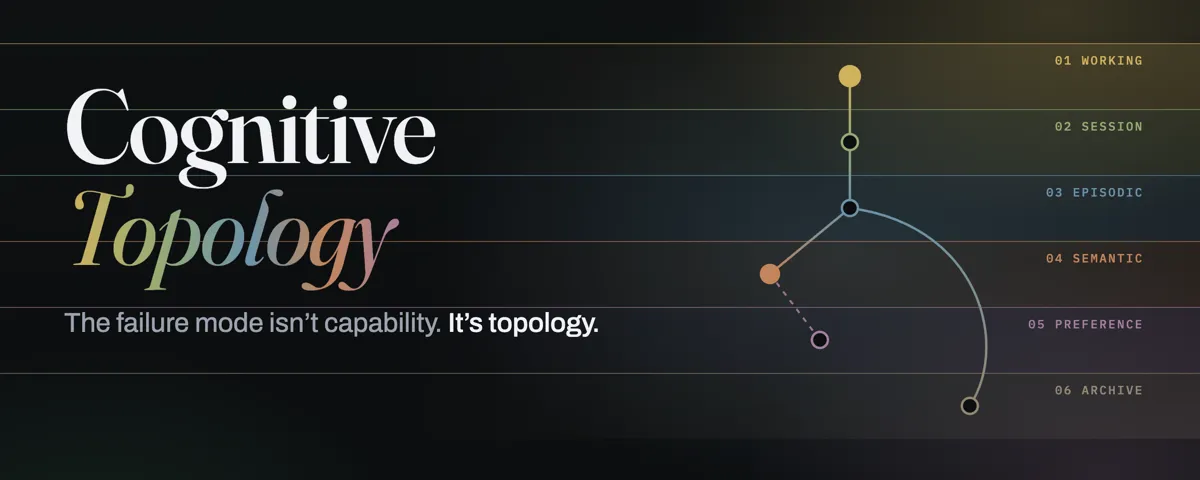
Cognitive Topology
The failure mode isn't capability. It's topology.
Models keep getting larger and the same failures keep happening: drift, contradictions, invented APIs, decisions that get lost between sessions. The paper argues the cause is structural. A bigger room does not make a meeting more productive.
Its answer is an architecture, four claims deep:
- Cognition is divisible. Planning is not implementation; criticism is not creation.
- Memory is plural. Working, episodic, and semantic memory should not share one buffer.
- Handoffs need a protocol. State crosses a boundary as a compressed packet, not a replayed transcript.
- Specs precede agency. An agent that writes a commitment, gets it ratified, and then acts against it is bounded.
What this is, and isn’t
It is a design argument and a specification, written by one person: 10 invariants, 12 agent roles, 6 memory tiers, and one handoff format. Those numbers describe the design. They are not results.
It does not report a controlled evaluation of the architecture. Stratum, a macOS workbench and CLI, is being built against it, and that is where it gets tested.
Read it
- The page: the argument in brief, with the four claims and the failure modes.
- The white paper (PDF, 34 pages): the full architecture.
- The reshape tessera: how the design was folded into Stratum, with the record.